


Search this question and you’ll get the same answer everywhere: reseal stamped concrete every two to three years.
That’s not what we’ve seen. The sealer we use has held up for at least four years on our own jobs, and often longer — not a number off a data sheet, but what we’ve watched happen on decks and patios we poured and have gone back to look at since.
So the honest answer is: it depends on what was put down, and the range is wider than most articles admit.
Why the two-to-three-year number exists
It’s not invented. Plenty of sealers genuinely do break down on that schedule, especially thinner acrylics applied in one coat. Under Solano County summers — long stretches of direct sun and real heat — a cheap sealer gives up faster than the label suggests.
The number also gets repeated by people who benefit from you resealing often. Worth knowing when you’re reading advice.
What actually determines the interval:
- What product went down, and how many coats. The single biggest factor, and the one you usually can’t see.
- Sun exposure. A west-facing pool deck with no shade ages differently than a covered patio.
- Traffic and use. Driveways take vehicle weight, hot tires, and oil. A back patio takes foot traffic and furniture.
- Chemicals. Pool chemistry, de-icers, fertilizer overspray from adjacent beds.
How to tell if yours is due
You don’t need a professional to check this. Three tests, all of which take under a minute.
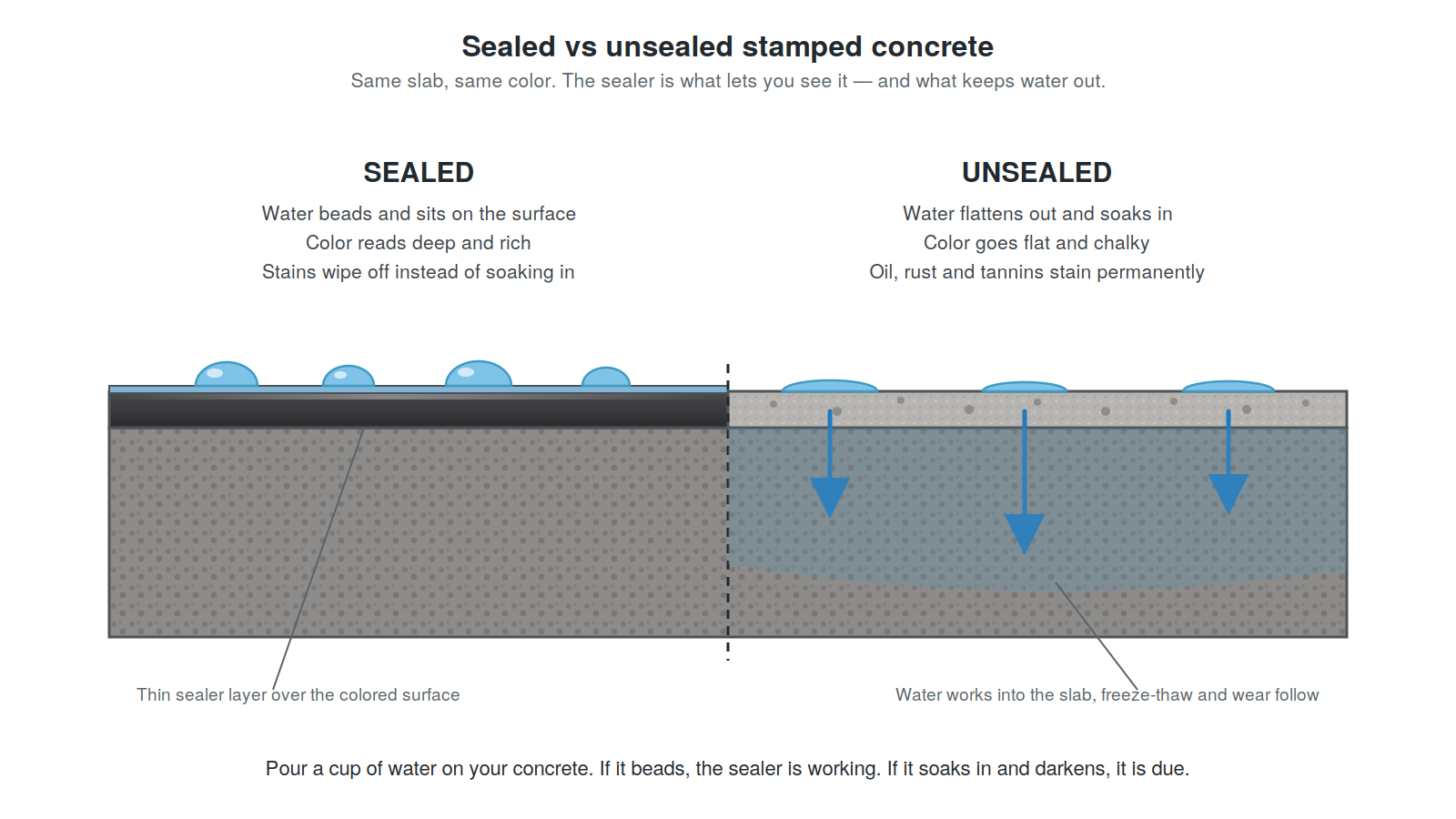
The water test. Pour a cup of water on the surface. If it beads and sits, the sealer is doing its job. If it soaks in and darkens the concrete, the sealer is gone or nearly gone.
The color test. Look at your concrete dry, in daylight, and compare it to how it looked when it was new. Sealer is what makes color read deep and rich. As it wears, color goes flat and chalky. Dark colors show this most — a black or charcoal surface can look grey when there’s nothing on it.
The wet test. Hose down a section. If the color jumps back to what you remember and then fades as it dries, that’s the sealer telling you it’s ready to be replaced.
What actually happens if you skip it
Nothing dramatic on any given day. That’s the problem — it’s gradual enough that people don’t notice until there’s real damage.
Color fades. UV works on exposed pigment. Unsealed color hardener will lighten and go chalky, and past a point it can’t be restored by sealing alone.
Stains set permanently. Unsealed concrete is porous. Oil, leaf tannins, barbecue grease, rust from furniture legs — all of it soaks in rather than sitting on top. Sealed, most of that wipes off.
Water gets in. The one that actually damages the slab. Water enters the pores, and repeated wet-dry and temperature cycling works on the surface from the inside. It shows up as surface flaking and worn stamp detail.
The pattern softens. Stamped concrete is bought for its texture. Erosion rounds off the crisp edges that made it look like stone in the first place.
A real example
We finished a front yard in Fairfield with retaining walls, steps and a front patio, poured with black color hardener. In photos it reads grey, not black — because it hasn’t been sealed yet.
That’s exactly the difference. The color is in the concrete; the sealer is what makes you able to see it. The homeowner hasn’t lost anything, and sealing will bring the black forward. But it’s a clear picture of what unsealed looks like versus what the same slab looks like finished.
Resealing is much cheaper than replacing
Worth stating plainly: resealing is maintenance. Replacing a deteriorated patio is a construction project. The gap between those two numbers is large, and staying on the right side of it is mostly a matter of not ignoring the water test for a decade.
Not sure where yours stands?
Do the water test today. If it soaks in, give us a call and we’ll take a look — whether we poured it or not.
We work throughout Fairfield, Vacaville, Napa, Dixon and Winters. Innovative Concrete Solutions is a father-and-son company with more than twenty years in the trade. CSLB #1118668, licensed and insured.