


This is the question we get most often on pool deck jobs, and it came up again on a recent project in the Green Valley area of Fairfield. The homeowner asked it during the estimate, before we’d priced anything: do I actually need drains, or is that an upsell?
Fair question. Here’s the honest answer.
It depends entirely on where the water can go
Concrete doesn’t absorb water. Every drop that lands on your pool deck has to go somewhere, and gravity decides where. Your only real choice is whether that direction was planned or accidental.
On a flat lot with open ground around it and natural fall away from the house, often you don’t need drains at all. Pitch the deck correctly and the water leaves on its own.
But a lot of pool decks aren’t in that situation. You need drains when:
- The house sits at or below the deck grade. Water running toward a foundation is the expensive problem. It doesn’t announce itself for a few winters, and then it does.
- The deck is boxed in. Fences, planters, retaining walls, or a slope behind the pool all trap water that would otherwise run off.
- The surrounding landscaping can’t take the volume. Lawn absorbs some. Bark and gravel beds move it around. Clay soil takes almost nothing and holds what it does.
- You have two different elevations. Wherever two grades meet, water collects at the seam unless something carries it away.
What we did in Green Valley
This one had most of those conditions at once. There was an aging wood deck on one side of the pool and old concrete on the other, sitting at two different elevations, with the house close by.
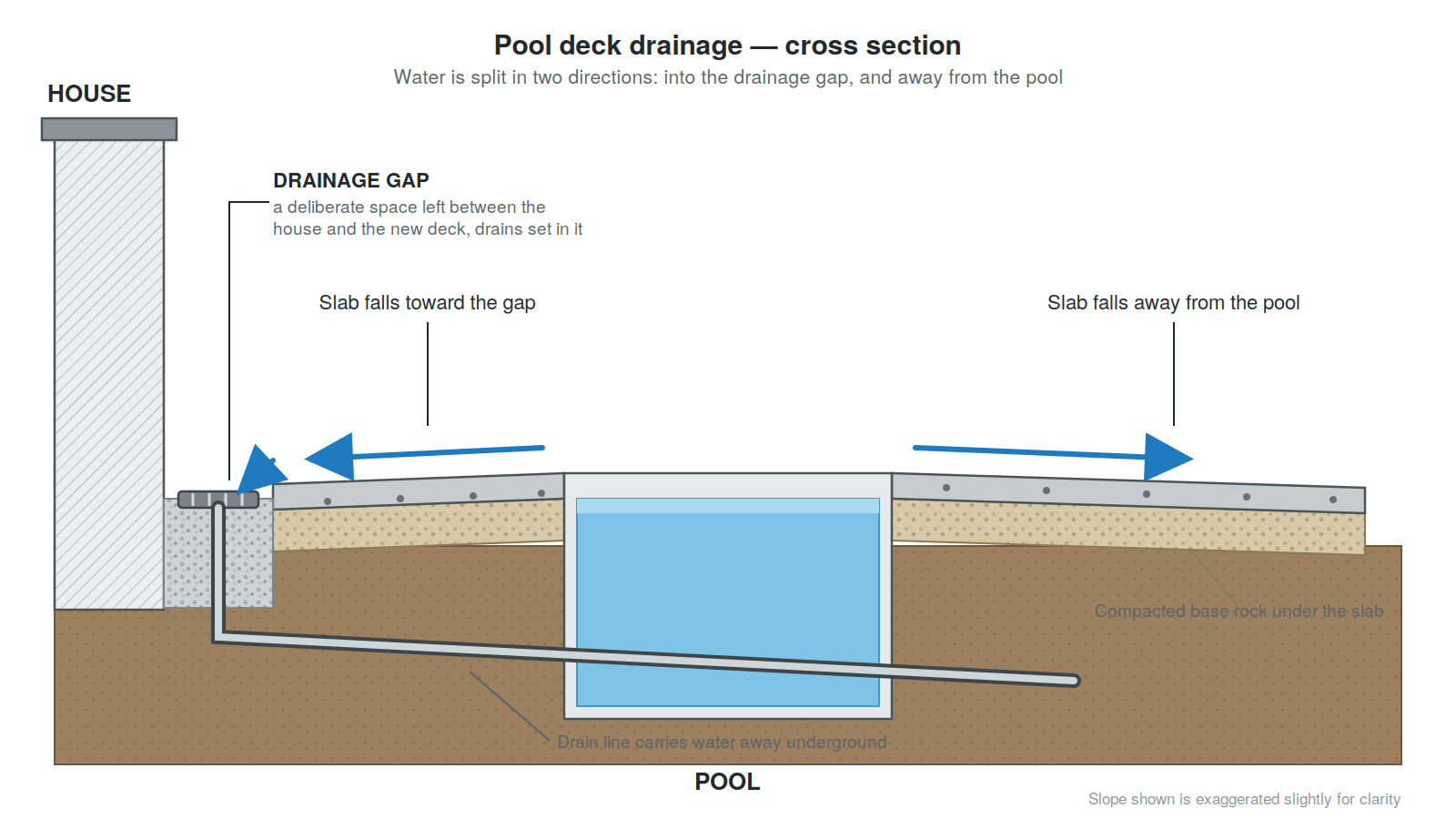
We removed both. Then, before pouring anything, we reset the grade so the two elevations became one continuous surface. We pitched it in two directions instead of one. On the pool’s right side, the deck carries water away from the pool and off the far edge, where the ground could take it. On the left side, between the house and the new deck, we left a deliberate gap, and installed area drains in that gap to take it away underground.
That gap is the part most homeowners would never think to ask for. It looks like a detail. It is the reason the house stays dry.
The finished deck is roughly 1,500 square feet of stamped concrete. What you can see in photos is the Roman Slate pattern. What you can’t see is the part that determines whether the homeowner is still happy in five years.
Why this has to be decided before the pour
This is the part worth understanding before you sign anything.
Drainage isn’t a feature you add to a finished deck. The fall is built into the grade under the slab and into the slope of the surface itself. The drain locations are set before concrete arrives. Once it cures, your options are cutting into new concrete, adding surface channels that were never part of the design, or living with it.
So when a contractor tells you drainage isn’t necessary, the right follow-up is: where does the water go instead? If there’s a clear answer — a natural fall to the street, open ground with good absorption — that may be perfectly true. If the answer is vague, that’s your signal.
What water in the wrong place actually costs
Two different problems, both avoidable:
Water against the foundation. Repeatedly saturated soil at the base of a house is a structural issue, not a cosmetic one. This is the one you don’t want to learn about the slow way.
Water running back into the pool. Runoff carries dirt, fertilizer, and whatever else is on the deck straight into the water. Your filtration and chemistry deal with it, on your dime.
There’s also the simple one: standing water on a deck people walk on barefoot. Concrete stays damp longer than you’d think, and damp concrete grows things.
How to know which situation you’re in
You don’t need to figure this out yourself. Any contractor worth hiring will walk the lot and tell you which way the ground falls, where water currently pools after a storm, and how close the house sits to the deck grade.
If you want to see it for yourself first, go out during the next real rain and watch. Where water sits after twenty minutes is where it will sit under your new deck too, unless someone changes the grade.
Talk to us about your lot
We pour pool decks throughout Fairfield, Vacaville, Napa, Dixon and Winters, and grade and drainage work is a large part of what we do. If you’re thinking about a new deck or replacing an old one, we’ll come look at the lot and tell you honestly whether drains belong in the plan.
Innovative Concrete Solutions is a father-and-son company with more than twenty years in the trade. CSLB #1118668, licensed and insured.